Most off-the-clock work is illegal when your employer requires it, permits it, or simply benefits from it, and you’re a nonexempt employee. If tasks before or after your shift are cutting into your paycheck, your first move is documentation, not confrontation: start a private log of dates, times, and what you did, save any timestamped emails or messages, and compare your notes to your pay stubs. The U.S. Department of Labor is the primary federal resource to confirm whether your specific situation qualifies.
TL;DR:
- Nonexempt employees are entitled to pay for all work performed beyond scheduled hours when their employer benefits from that time.
- Off-the-clock work includes tasks like finishing jobs after hours, preparing equipment early, or responding to messages outside scheduled times, which are often overlooked.
- Accurate documentation such as personal logs, electronic timestamps, and witness accounts is crucial for proving unpaid work, especially when records are missing or disputed.
- The standard statute of limitations for recovering unpaid wages is two years, extending to three years for willful violations, making prompt action vital.
- Employers must maintain precise recordkeeping; signs of violations include uncorrected timecard edits and a culture expecting unpaid overtime.
Table of Contents
- What Counts as Off the Clock Work Under Federal Law?
- Are You Exempt or Nonexempt, and Why Does It Matter?
- What Are Common Examples of Compensable Off-the-Clock Work?
- When Is Unpaid Time Actually Compensable?
- How Do You Document and Prove Off-the-Clock Work?
- How Do You Recover Unpaid Wages?
- What Are Employer Recordkeeping Duties and Red Flags?
- How Can Workplace Fairness Resources Help You Build a Case?
- What Would I Prioritize If Off-the-Clock Requests Kept Happening?
- Workplace Fairness: Where to Start Building Your Case
- Where Can You Find the Primary Sources?
- Sources
What Counts as Off the Clock Work Under Federal Law?
The Fair Labor Standards Act requires covered nonexempt employees to be paid for all “hours worked,” and that phrase covers any time you’re required or permitted to be on duty or on your employer’s premises performing work, according to DOL Fact Sheet #22. This is where the “suffer or permit to work” doctrine comes in: if your employer allows the work to happen and benefits from it, they owe you for it, even if no one explicitly told you to do it. A written policy banning off-the-clock work does not erase that obligation. Short breaks of 20 minutes or less are typically paid time, while genuine meal periods of 30 minutes or more, where you’re fully relieved of duties, generally are not.
Are You Exempt or Nonexempt, and Why Does It Matter?
Your classification decides almost everything here. Nonexempt employees are entitled to minimum wage and overtime for every hour worked, including the off-the-clock kind. Exempt employees, typically certain salaried executive, administrative, or professional roles, fall outside most of these protections.
The trouble is that misclassification happens often, and it happens quietly. An employee handed a salary and a fancy title isn’t automatically exempt; the actual duties performed determine that status, not the paycheck structure. If you suspect your role was mislabeled to sidestep overtime pay, that misclassification itself can become part of a wage claim. Workplace Fairness breaks down the distinction in detail in its exempt versus nonexempt guide, and it’s worth reading before you assume the rules don’t apply to you.
What Are Common Examples of Compensable Off-the-Clock Work?
Courts and the DOL have treated a consistent set of scenarios as compensable time, even when employees weren’t technically clocked in. These include:
- Finishing a task after your shift ends because a customer or deadline demanded it
- Prepping equipment, uniforms, or workstations before your official start time
- Attending mandatory meetings or briefings scheduled before clock-in
- Completing unpaid training required for your job
- Responding to a supervisor’s calls, texts, or emails outside scheduled hours
- Using an employer-provided phone or laptop to handle work tasks after hours
Some states go further than federal law. California, for example, applies stricter daily overtime thresholds and tighter meal and rest break rules, so a scenario that’s a gray area federally might be a clear violation under state law.
When Is Unpaid Time Actually Compensable?
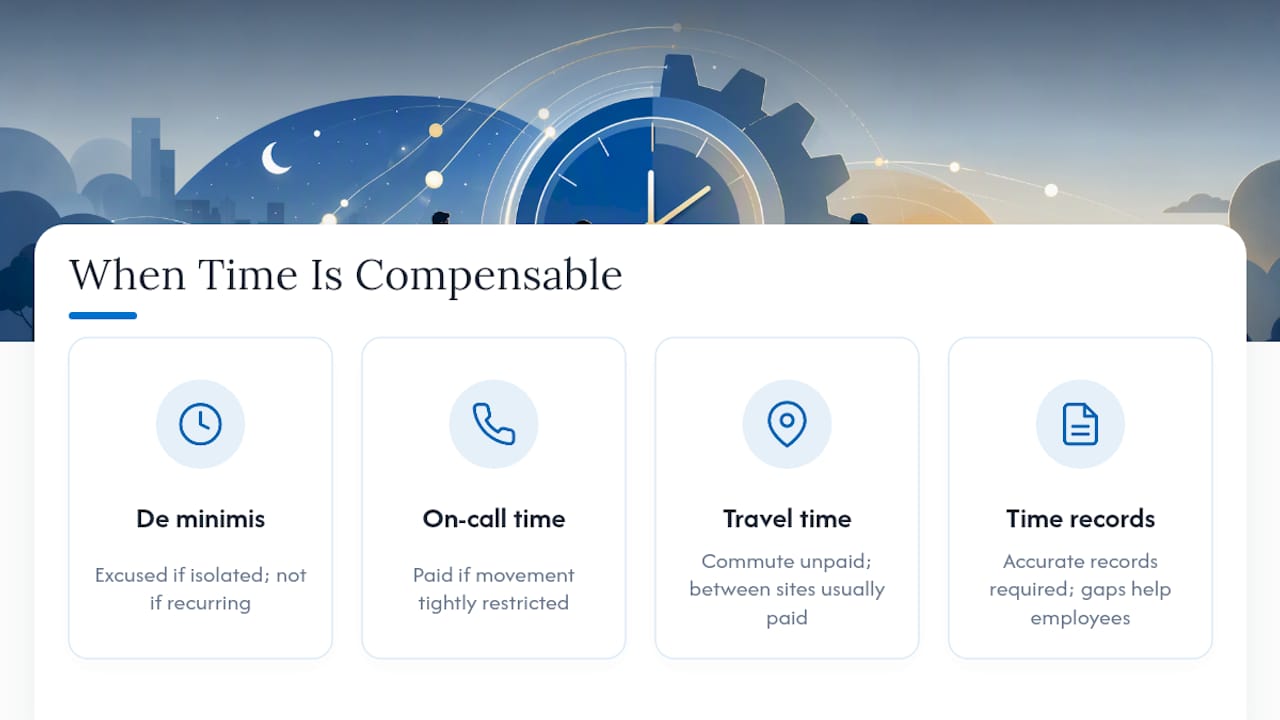
A handful of legal tests decide the close calls. “De minimis” time, meaning a few minutes here and there, was historically treated as too small to bother tracking, but courts have grown skeptical of that excuse when the minutes add up across a workforce or repeat daily. On-call and waiting time counts as hours worked when restrictions on your movement are tight enough that you can’t meaningfully use that time for yourself; the more freedom you have while waiting, the weaker your claim.
Travel time follows its own logic. Your regular commute isn’t paid, but travel between job sites during the workday usually is. Underneath all of these tests sits a basic requirement: employers must keep accurate time records. When those records don’t exist or don’t match reality, that gap often works in the employee’s favor during an investigation.
How Do You Document and Prove Off-the-Clock Work?
Building a credible claim comes down to consistency, not volume. A few solid weeks of clean records beat a vague memory of “working late a lot.”
- Keep a personal time log. Note the date, start and stop times, and a one-line description of what you did, updated the same day rather than reconstructed later.
- Save electronic evidence. Email timestamps, chat logs, calendar invites, and even GPS or device login timestamps all corroborate your log.
- Compare your records against payroll. Request copies of your timecards and pay stubs where possible, and note discrepancies without altering anything on your employer’s system.
- Gather witness accounts. Co-workers facing the same unpaid expectations strengthen a claim considerably, especially when their experience mirrors yours across multiple shifts.
Pro Tip: Keep your log somewhere your employer can’t access, like a personal notebook or a private cloud account, not a shared work drive.
How Do You Recover Unpaid Wages?
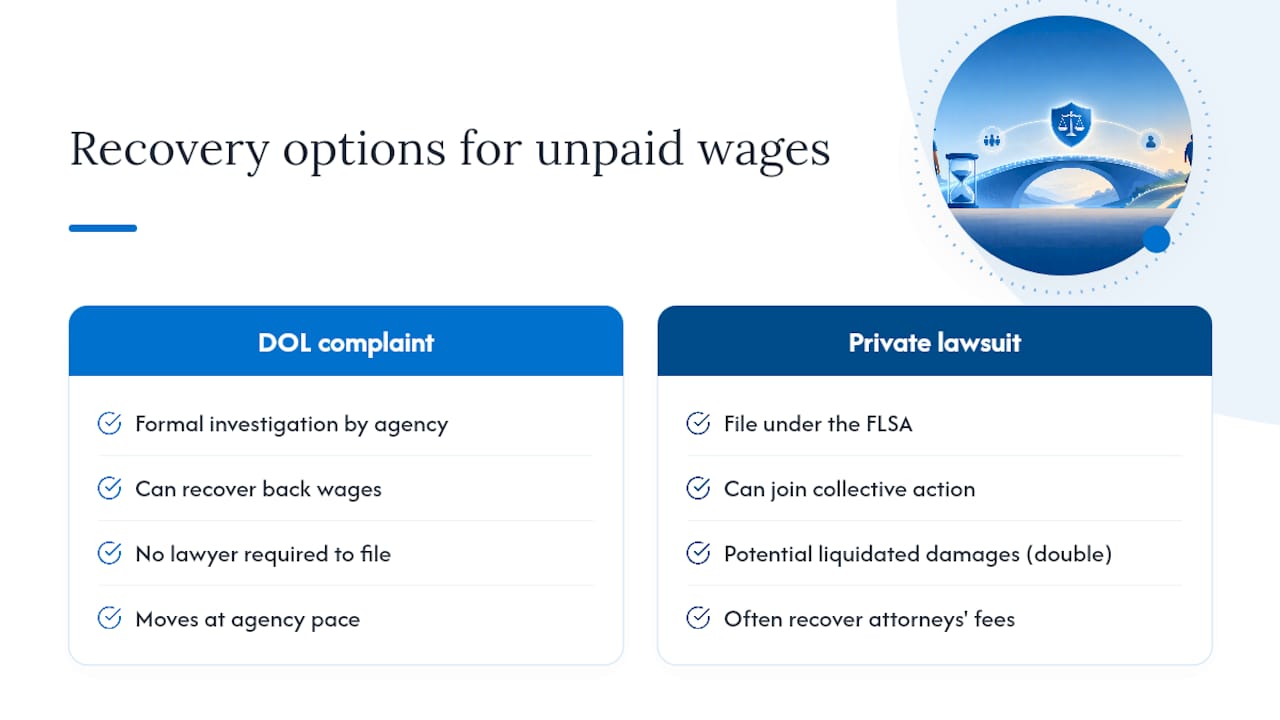
You generally have two paths: filing a complaint with the DOL’s Wage and Hour Division, or pursuing a private lawsuit under the FLSA, sometimes alongside co-workers in a collective action. A DOL complaint can trigger a formal investigation and recover back wages without you hiring a lawyer, though it moves at a government agency’s pace.
Private suits carry their own advantages, including potential liquidated damages that can double what you’re owed, plus recovery of attorneys’ fees in many cases. Timing matters: the standard statute of limitations under the FLSA is two years, stretching to three years if the violation was willful. That clock is one more reason to start documenting now rather than later. Before filing anything, gather your time log, any electronic evidence, and pay records. If your situation involves a pattern affecting multiple employees, or you’re unsure which route fits, Workplace Fairness’s guide to labor standards enforcement walks through how DOL and state agencies typically handle these cases.
What Are Employer Recordkeeping Duties and Red Flags?
Employers covered by the FLSA must keep accurate payroll and time records under DOL recordkeeping rules, including hours worked each day and total wages paid. Watch for a few warning signs: timecards that get “corrected” downward after the fact, managers who discourage reporting overtime, or an unofficial culture where finishing work off the clock is simply expected. None of these justify the practice; an employer that benefits from unpaid work but never actively stops it is still on the hook under the suffer or permit to work standard.
How Can Workplace Fairness Resources Help You Build a Case?
Workplace Fairness maintains free guides covering unpaid overtime, on-call pay, and recordkeeping expectations, each written to mirror the categories a DOL complaint actually asks about: dates, hours, job duties, and pay records. As a nonprofit informational resource, Workplace Fairness doesn’t file complaints on your behalf, but its guides help you organize what you already have before you approach the DOL or an attorney.
What Would I Prioritize If Off-the-Clock Requests Kept Happening?
Document everything first, before you say a word to anyone at work; retaliation protections exist, but a paper trail protects you better than a policy does. Try raising it with HR once, briefly and in writing. If nothing changes within a pay cycle or two, escalate to the DOL or a wage-and-hour attorney rather than waiting it out.
— Max
Workplace Fairness: Where to Start Building Your Case
There are free, plain-language guides you can read at your own pace, before you decide whether you need a lawyer at all. Unlike a paid consultation that starts a clock the moment you dial in, these resources cost nothing and carry no obligation.
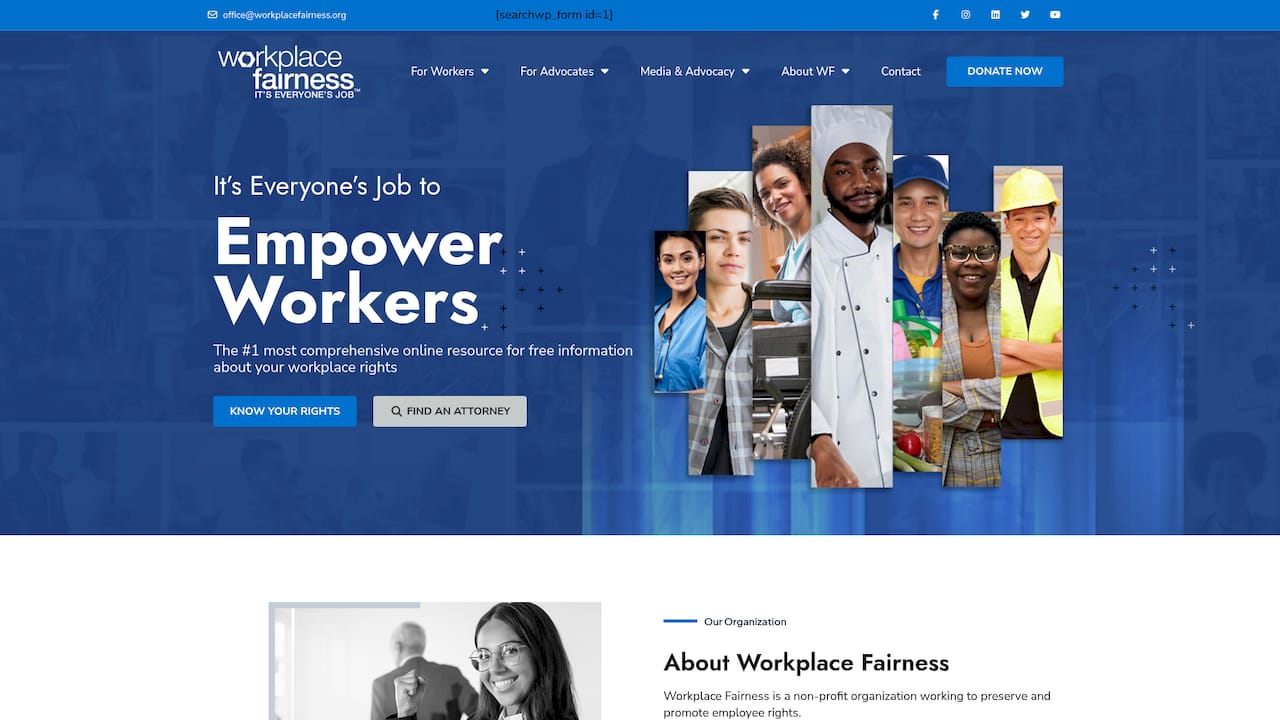
Start with the Workplace Fairness guide for employees to understand how the organization’s resources and attorney directory work together. If unpaid hours are only part of a bigger pattern at your job, the employee rights guide covers protections beyond wages, and the always-on culture driving so much unpaid work often ties into broader burnout concerns that groups like Day Off address from the well-being side. Save the checklist from this article, pull your records together, and when you’re ready, use Workplace Fairness’s attorney directory to find someone who handles wage claims in your state.
Where Can You Find the Primary Sources?
For direct reference: DOL’s hours worked fact sheet and recordkeeping rules, the systematic review on after-hours connectivity, and Workplace Fairness’s unpaid overtime guide.
This article is general information, not a substitute for advice from a qualified lawyer. Consult a qualified legal professional about your own circumstances before acting on anything here.
Sources
- Fact Sheet #22: Hours Worked Under the Fair Labor Standards Act (FLSA) | U.S. Department of Labor
- Suffer or Permit to Work – FLSA Hours Worked Advisor
- What do we know about limiting after-hours availability expectations and work-related connectivity? A systematic review of interventions and policies