Labor standards enforcement is the process by which government agencies compel employers to follow labor laws that protect workers’ rights, including fair wages, safe conditions, and lawful working hours. This is not aspirational guidance. It is a legally binding system with real consequences for employers who violate the rules. The U.S. Department of Labor, state labor agencies, and local enforcement bodies all play roles in this system. Understanding what is labor standards enforcement gives you the knowledge to recognize when your rights are being violated and what you can do about it. Workplacefairness has supported workers in building that knowledge since 1994.
What is labor standards enforcement and why does it matter?
Labor standards enforcement is the mechanism that turns written law into workplace reality. Without it, protections like minimum wage and overtime rules would exist only on paper. The distinction between labor standards and labor laws is worth understanding: labor standards are aspirational benchmarks set by bodies like the International Labour Organization, while labor laws are legally binding rules enforced by agencies with real authority. Confusing the two leads workers to overestimate or underestimate their legal remedies.
The enforcement gap, which the ILO identifies as a critical threat to worker welfare, is the distance between what the law says and what actually happens in workplaces. That gap exists wherever reporting is low, agencies are underfunded, or workers do not know their rights. Closing it requires both strong legal frameworks and workers who understand how to use them.
The core protections covered by enforcement of labor laws include minimum wage, overtime pay, workplace safety, anti-discrimination rules, and family and medical leave. These protections apply across industries, though specific rules vary by employer size, sector, and location. Knowing which laws apply to your job is the first step toward protecting yourself.

What does federal labor standards enforcement cover?
Federal enforcement centers on the Fair Labor Standards Act, commonly called the FLSA. The FLSA requires covered nonexempt employees to receive at least the federal minimum wage and overtime pay at 1.5 times their regular rate for every hour worked beyond 40 in a workweek. That overtime rule is one of the most frequently violated provisions in American workplaces.
The U.S. Department of Labor’s Wage and Hour Division investigates complaints, conducts audits, and recovers unpaid wages on behalf of workers. The scale of this work is significant. In fiscal year 2025, the Department of Labor recovered $259 million in back wages for nearly 181,000 workers, the highest annual recovery since 2019. That figure shows how widespread wage theft remains, and how consequential enforcement actions can be for individual workers.
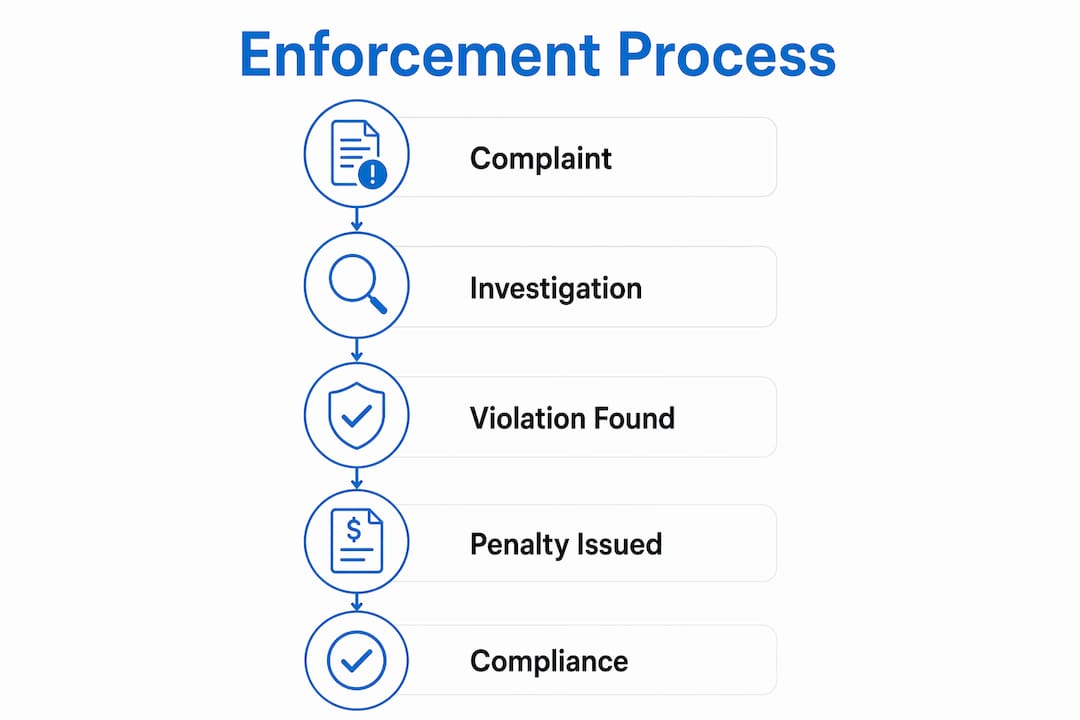
The enforcement process typically works as follows:
- A worker files a complaint with the Wage and Hour Division online, by phone, or in person
- An investigator reviews payroll records, timesheets, and employment agreements
- If a violation is found, the employer must pay back wages and may face civil penalties
- Workers cannot be retaliated against for filing a complaint under federal law
Pro Tip: Keep your own records of hours worked and wages paid. Personal documentation strengthens any complaint you file with a labor agency, especially when employer records are incomplete or disputed.
The FLSA also covers child labor rules and recordkeeping requirements for employers. Workers in agriculture, domestic service, and certain small businesses face different coverage thresholds, so checking your specific classification matters. Workplacefairness provides plain-language guides on overtime rule changes that affect how these protections apply in practice.
How do state and local rules expand your protections?
State and local labor standards enforcement has become the primary driver of worker protections in 2026. Regulatory complexity now comes largely from state and local authorities rather than federal action, meaning your location determines much of what you are owed. Workers who assume federal rules are the ceiling are often leaving protections on the table.
The table below shows how state and local rules commonly exceed federal minimums:
| Protection type | Federal standard | State/local example |
|---|---|---|
| Minimum wage | $7.25/hour | Many cities exceed $17/hour |
| Paid sick leave | No federal mandate | Most states require it |
| Pay transparency | No federal requirement | At least 16 states plus D.C. require salary ranges in job postings |
| Overtime eligibility | Salary threshold set federally | Some states apply broader tests |
At least 16 states plus Washington, D.C. now require employers to disclose salary ranges in job postings, with fines reaching $10,000 per violation. That shift gives workers a concrete negotiating tool and a new enforcement avenue if employers refuse to comply.
Workers often incorrectly assume federal protections are uniform nationwide. Local jurisdictions may have higher minimum wages and broader leave laws that change what you are legally owed. The rule is simple: the most protective law that applies to your situation governs your rights. Always check the rules for the city or county where you physically work, not just your employer’s home state.
State labor agencies enforce these local rules independently of the federal Department of Labor. Filing a complaint at the state level is often faster and may yield stronger remedies depending on your jurisdiction.
What violations are most common and what can workers expect?
The most common labor law violations fall into predictable patterns. Employers misclassify workers to avoid paying benefits, shave hours from timesheets, fail to pay overtime, or pay below the applicable minimum wage. These are not edge cases. They are the violations that account for the majority of back wage recoveries every year.
Penalties for employers are real and can be substantial. Non-compliance fines range from $250 to $10,000 per violation depending on the state and the specific regulation. Repeat or willful violations carry higher penalties, and the Department of Labor can refer egregious cases for criminal prosecution.
Common violations workers should watch for include:
- Unpaid overtime for hours worked beyond 40 in a week
- Minimum wage shortfalls, especially for tipped workers
- Illegal deductions from paychecks
- Failure to provide legally required paid leave
- Misclassification as an independent contractor to avoid wage protections
When enforcement actions succeed, workers receive back wages directly. The enforcement gap identified by the ILO means many violations go unreported and unresolved. Reporting is the act that triggers the system. Without a complaint or an audit, most violations remain invisible to agencies.
How can workers engage with enforcement to protect their rights?
Protecting your rights starts with understanding your classification. Employee classification directly determines whether labor standards protections apply to you. The Department of Labor uses an economic reality test to assess whether a worker is genuinely an independent contractor or is, in practice, an employee. If you are misclassified as a contractor, you may be owed minimum wage, overtime, and other protections you are currently not receiving.
Follow these steps to engage with the enforcement process effectively:
- Document everything. Keep copies of pay stubs, schedules, timesheets, and any written communications about your pay or hours.
- Identify the right agency. Federal complaints go to the Department of Labor’s Wage and Hour Division. State complaints go to your state labor department. Some violations fall under both.
- File your complaint. You can file online, by phone, or in person. Federal complaints are confidential, and retaliation is illegal.
- Follow up. Investigations take time. Ask for a case number and check in periodically.
- Seek additional support. Advocacy organizations and legal aid groups can help you understand your options, especially if your employer retaliates.
Pro Tip: Filing a complaint does not require a lawyer. The Wage and Hour Division investigates on your behalf at no cost to you. Legal representation becomes more valuable if you pursue a private lawsuit after an agency investigation.
Understanding your rights as a worker also means knowing what protections exist beyond wages, including anti-retaliation rules, whistleblower protections, and the right to organize. Workplacefairness offers detailed resources on each of these areas for workers navigating complex situations.
Key Takeaways
Labor standards enforcement is only as effective as the workers who understand and use it. Every complaint filed, every wage claim submitted, and every misclassification challenged strengthens the system for everyone.
| Point | Details |
|---|---|
| Enforcement is legally binding | Labor laws carry real penalties; agencies can recover wages and fine employers up to $10,000 per violation. |
| Federal FLSA sets the floor | Overtime at 1.5x pay kicks in after 40 hours per week; state and local rules often go further. |
| Local rules frequently exceed federal standards | Check the laws where you physically work, not just your employer’s home state. |
| Classification determines your protections | Misclassified contractors may be owed wages and benefits they are currently not receiving. |
| Reporting triggers enforcement | Agencies cannot act on violations they do not know about; filing a complaint is the first step. |
Why workers cannot afford to be passive about enforcement
The labor standards system is built on the assumption that workers will use it. That assumption breaks down when workers do not know their rights or fear retaliation for speaking up. I have seen this pattern repeat across industries and income levels. The workers who recover unpaid wages are almost always the ones who documented their situation and filed a complaint, not the ones who waited for an employer to self-correct.
What strikes me most about the current moment is how much enforcement power has shifted to the state and local level. Federal action has been inconsistent, but cities and states have moved aggressively on minimum wage, paid leave, and pay transparency. Workers who only track federal rules are operating with an incomplete picture of what they are owed.
The most underused protection in the system is the anti-retaliation rule. Many workers stay silent because they fear losing their jobs. Federal and most state laws prohibit employers from firing, demoting, or threatening workers who file complaints. That protection is real, and it matters. Knowing it exists changes the calculation for workers who are weighing whether to speak up.
My honest advice: treat your pay records the way you treat your tax documents. Keep them, organize them, and review them regularly. The workers who can show exactly what they were paid and when are the ones who win wage claims. The ones who rely on memory rarely do.
— Max
Workplacefairness resources for workers on labor rights
Workers who understand their rights are far better positioned to use the enforcement system effectively. Workplacefairness has provided free, plain-language guidance on employment law since 1994, connecting workers with the information they need to recognize violations and take action.
The workplace rights guide for 2026 covers the protections every employee should know, from wage rules and overtime to anti-discrimination laws and leave entitlements. Whether you are starting a new job or questioning whether your current employer is treating you fairly, Workplacefairness offers the context and clarity to help you move forward with confidence. The site also covers wage violations and recovery options for workers who believe they have been underpaid.
FAQ
What is the labor standards definition in plain terms?
Labor standards are the minimum conditions employers must provide workers, including fair wages, safe workplaces, and lawful hours. When these standards are set by law, government agencies enforce them through investigations, penalties, and wage recovery.
How is labor enforced at the federal level?
The U.S. Department of Labor’s Wage and Hour Division enforces federal labor laws by investigating complaints, auditing employers, and recovering unpaid wages. In fiscal year 2025, the agency recovered $259 million in back wages for nearly 181,000 workers.
What is the difference between labor standards and labor laws?
Labor standards are aspirational benchmarks, often set by bodies like the ILO, while labor laws are legally binding rules enforced by government agencies. Only labor laws carry penalties and enforcement mechanisms that workers can directly use.
Can my employer fire me for filing a labor complaint?
Retaliation against workers who file complaints is illegal under federal law and most state laws. Employers who retaliate face additional penalties, and workers can file a separate retaliation complaint with the relevant agency.
How do I know which labor rules apply to my job?
The most protective law that covers your situation governs your rights. Check federal rules first, then your state’s labor laws, then the rules for the city or county where you physically work, since local ordinances often exceed state and federal minimums.