Workplace rights for new employees are the legal protections that guarantee fair pay, safe conditions, and freedom from discrimination starting on day one of employment. Federal standards like the Fair Labor Standards Act (FLSA), the Equal Employment Opportunity Commission (EEOC), and the Occupational Safety and Health Administration (OSHA) form the backbone of these protections. Understanding your rights before a problem arises is the most effective way to protect yourself. Workplacefairness has supported workers in this effort since 1994, and the guidance below reflects the most current legal standards available to new hires today.
1. What are the essential workplace rights every new employee should know?
New hire legal rights begin the moment employment starts. Federal law sets a floor of protections that apply regardless of your employer’s size, industry, or internal policies.
Minimum wage and overtime pay
The federal minimum wage is $7.25 per hour, and overtime pay is set at 1.5 times your regular hourly rate after 40 hours in a workweek. Many states set higher minimums, so the rate in your state may exceed the federal floor. Always confirm which rate applies to your specific location.

Protection from discrimination
Title VII of the Civil Rights Act, the Age Discrimination in Employment Act, and the Americans with Disabilities Act collectively prohibit discrimination based on race, sex, age (40 and older), and disability. These protections apply from your first day. Filing a complaint with the EEOC is the standard path when discrimination occurs.
The right to a safe workplace
OSHA requires every employer to provide a workplace free from recognized hazards. You have the right to report unsafe conditions without fear of punishment. OSHA also gives you the right to request an inspection if you believe your workplace is dangerous.
Family and medical leave
The Family and Medical Leave Act (FMLA) entitles eligible employees to up to 12 weeks of unpaid, job-protected leave per year for qualifying medical or family reasons. Eligibility requires working for a covered employer for at least 12 months and logging at least 1,250 hours in the prior year. New hires who do not yet meet this threshold should track their hours carefully.
The right to organize
The National Labor Relations Act (NLRA) protects your right to organize, join a union, and engage in collective bargaining. This right applies whether or not your workplace is currently unionized. Employers cannot legally punish you for discussing wages with coworkers or participating in protected organizing activity.
Retaliation protections
Federal law prohibits retaliation against employees who exercise their rights, including reporting safety violations, filing discrimination complaints, or requesting reasonable accommodations. Retaliation can take many forms, including demotion, reduced hours, or termination. Any adverse action taken shortly after a protected activity is a red flag worth documenting.
At-will employment and its limits
Most U.S. employment is at-will, meaning your employer can terminate you at any time for any lawful reason. The critical limit is that termination cannot be based on illegal discrimination or retaliation. Understanding this distinction prevents the common mistake of assuming at-will status removes all protections.
Pro Tip: Ask your HR contact on your first day whether your role is classified as exempt or non-exempt under the FLSA. That single answer determines whether you are entitled to overtime pay.
2. How probationary periods and employment classifications affect your rights
Probationary periods do not suspend your legal protections. Fundamental rights against discrimination, unsafe conditions, and unlawful retaliation remain fully intact during any trial period an employer sets. Probation is an internal performance tool, not a legal status that reduces your rights.
Employment classification, however, does affect specific entitlements. The FLSA divides workers into two categories:
- Exempt employees are generally salaried professionals, executives, or administrators who do not qualify for overtime pay.
- Non-exempt employees are entitled to overtime at 1.5 times their regular rate for every hour worked beyond 40 in a week.
- Independent contractors fall outside most federal employee protections entirely, which is why misclassification is a serious issue.
Misclassification as exempt when you should be non-exempt is one of the most common wage violations new hires face. If your duties are primarily routine and your pay is hourly, question an exempt classification.
Non-compete and non-solicitation agreements add another layer of complexity. Massachusetts limits the enforceability of non-competes for non-exempt employees, and many such clauses are negotiable before signing. Read every restrictive covenant carefully. If a clause limits where you can work after leaving, ask an employment attorney to review it before you sign.
Pro Tip: Never assume a probationary period means you have fewer rights. Ask your employer in writing what the probation period covers and what standards determine its outcome.
3. What written documents and notices new employees should receive
New employees should receive written terms covering pay, hours, job title, and leave entitlements on or before their first day. This is both a legal standard in many jurisdictions and a practical protection for you. A written record prevents disputes about what was agreed.
California raised the bar significantly in 2026. The Workplace Know Your Rights Act now requires employers to provide written notices to new hires, with penalties of $500 per employee for failure to comply. Emergency contact form violations carry penalties of up to $500 per day, capped at $10,000. That financial exposure gives California employers a strong incentive to comply, and it signals a broader national trend toward stricter new hire disclosure requirements.
Every new employee should collect and keep the following documents:
- Offer letter or employment contract confirming your title, salary, and start date
- Written statement of terms covering pay, hours, holidays, and leave policies
- Employee handbook outlining workplace policies and complaint procedures
- Pay stubs from every pay period as a record of wages earned and deductions taken
- Copies of any agreements signed, including non-competes, confidentiality clauses, and arbitration agreements
| Document | Why it matters |
|---|---|
| Offer letter | Confirms agreed pay and title in writing |
| Written terms statement | Establishes your legal entitlements from day one |
| Pay stubs | Provides evidence of wage compliance or violations |
| Signed agreements | Defines restrictions and obligations you accepted |
| Complaint records | Creates a paper trail if disputes escalate |
Keeping personal copies of these documents outside of company systems is critical. If your access is revoked after a dispute, you still have your records.
4. What to do when you believe your rights have been violated
Acting quickly matters. Many enforcement agencies impose strict filing deadlines, and missing them can eliminate your ability to seek relief.
Step 1: Document everything
Maintaining copies of offer letters, pay stubs, performance reviews, and written complaints creates the evidence base for any claim. Write down dates, times, locations, and the names of anyone present during incidents. A contemporaneous record is far more credible than memory recalled months later.
Step 2: Know which agency handles your complaint
- OSHA handles workplace safety violations.
- EEOC handles discrimination and harassment complaints.
- Department of Labor (DOL) handles wage and hour violations under the FLSA.
- National Labor Relations Board (NLRB) handles violations of organizing and collective bargaining rights.
Each agency has its own process, deadlines, and remedies. Filing with the wrong agency wastes time. The workplace discrimination complaint process guide from Workplacefairness walks through how to file correctly.
Step 3: Report internally first when safe to do so
HR reporting creates a formal record and gives the employer a chance to correct the problem. If your workplace has a union, your representative can accompany you to meetings and help you navigate the process. Internal reporting also demonstrates good faith if the matter later goes to an agency or court.
Step 4: Seek legal advice
An employment attorney can assess your situation confidentially and tell you whether you have a viable claim. Many offer free initial consultations. You can also review your social media rights as an employee, since online activity is increasingly relevant in workplace disputes.
Pro Tip: File agency complaints as soon as possible. EEOC discrimination charges generally must be filed within 180 days of the discriminatory act, or 300 days in states with their own anti-discrimination agencies.
Key takeaways
New employees hold full legal protections from day one, and knowing which laws apply, which agencies enforce them, and how to document violations is the most reliable defense against unfair treatment.
| Point | Details |
|---|---|
| Rights start immediately | Federal protections under FLSA, OSHA, and EEOC apply from your first day of work. |
| Probation does not reduce rights | Employers cannot suspend discrimination or safety protections during a trial period. |
| Written documents are your protection | Collect and store your offer letter, pay stubs, and signed agreements outside company systems. |
| Act fast on violations | EEOC deadlines can be as short as 180 days, so document and report without delay. |
| Classification determines overtime | Confirm exempt or non-exempt status on day one to know whether overtime pay applies to you. |
What I’ve learned watching new hires navigate their first weeks
New employees consistently underestimate how much their first-week paperwork shapes their entire employment relationship. I have seen workers sign arbitration agreements without reading them, accept exempt classifications without questioning them, and assume probation means they have no recourse if something goes wrong. Every one of those assumptions costs them later.
The at-will doctrine is the most misunderstood concept in American employment law. Workers hear “at-will” and conclude they have no protection. The reality is that at-will status only removes the requirement for cause in termination. It does not touch discrimination law, retaliation law, or wage law. Knowing that distinction changes how you respond when something feels wrong.
Proactive documentation is the single habit that separates employees who successfully assert their rights from those who cannot. You do not need to be adversarial about it. Simply keeping a personal folder with your offer letter, pay stubs, and a running log of any concerning incidents gives you options. Most workers who struggle to prove a violation do so because they have no contemporaneous record.
The workers I most respect are the ones who ask clarifying questions on day one, read what they sign, and treat their employment terms as a contract worth understanding. That posture is not paranoia. It is the foundation of a fair working relationship, and it is exactly what Workplacefairness has advocated for since its founding as the National Employee Rights Institute in 1994.
— Max
Workplacefairness resources for new employees
Starting a new job brings a lot of paperwork, new policies, and unfamiliar processes. Knowing where to find reliable guidance makes a real difference when questions arise.
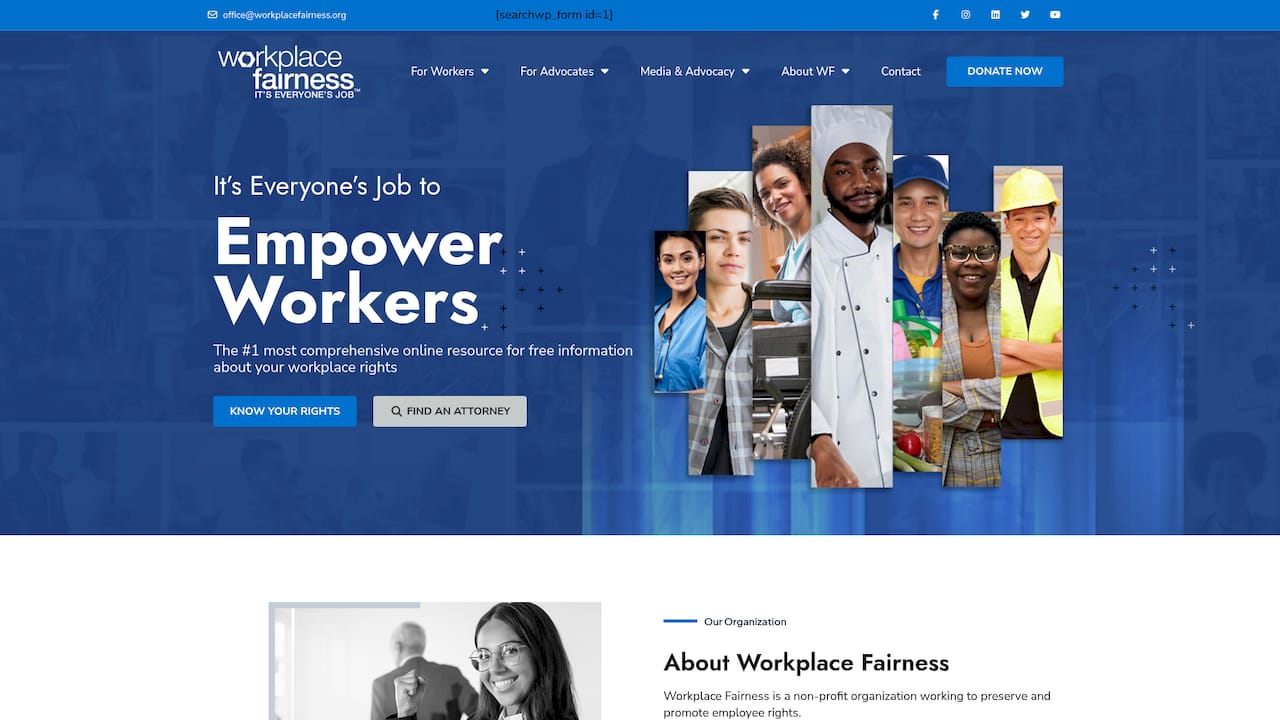
Workplacefairness provides free, accessible resources covering the full range of employee workplace protections, from wage and hour rules to discrimination complaint procedures. The labor law resource guide offers trusted alternatives for workers seeking authoritative information beyond government portals. For employees wanting a broader foundation in employment law basics, the right-to-work guide explains how union and non-union workplaces differ and what that means for your rights. Workplacefairness has connected workers with employment rights attorneys and advocacy organizations for over 30 years, and those resources remain available to you now.
FAQ
What rights do new employees have from day one?
New employees are protected by federal law from day one, including minimum wage guarantees under the FLSA, anti-discrimination protections under Title VII and the EEOC, and workplace safety rights under OSHA. Probationary status does not reduce these protections.
Does at-will employment mean an employer can fire me for any reason?
At-will employment allows termination without cause, but it does not permit termination based on illegal discrimination, retaliation for protected activity, or other unlawful reasons. Those limits apply regardless of at-will status.
What documents should I receive when starting a new job?
You should receive a written statement of your job title, pay, hours, and leave entitlements on or before your first day. California’s 2026 Workplace Know Your Rights Act also requires specific written notices, with penalties of $500 per employee for noncompliance.
How do I report a workplace rights violation?
File a complaint with the relevant federal agency: OSHA for safety issues, the EEOC for discrimination, the DOL for wage violations, or the NLRB for organizing rights violations. Document the incident thoroughly before filing and act quickly, since deadlines can be as short as 180 days.
Are non-compete agreements enforceable for new employees?
Enforceability varies by state. Massachusetts, for example, limits non-compete enforcement for non-exempt employees. Many restrictive covenants are negotiable before signing, and an employment attorney can assess whether a specific clause is enforceable in your state.