
Day laborer wage protections guarantee minimum wage and overtime pay to every worker, regardless of how informally they were hired or what their immigration status is. The Fair Labor Standards Act (FLSA) sets the federal floor, and stronger state laws like California’s Labor Code and Illinois’s Day and Temporary Labor Services Act build on top of it. If you work as a day laborer, you have real, enforceable rights. Knowing them is the first step toward collecting every dollar you are owed.
What are the minimum wage and overtime rights for day laborers?
Federal law requires employers to pay no less than $7.25 per hour and at least 1.5 times your regular rate for every hour above 40 in a workweek. That baseline applies whether you were hired at a street corner, through a staffing agency, or by a neighbor who needed help for a day. The informal nature of the arrangement does not change your legal entitlement.
Many states set a higher floor. California’s minimum wage is $16.90 per hour in 2026, and California overtime kicks in after 8 hours in a single day, not just after 40 hours in a week. That daily overtime rule is far more protective than the federal standard and directly benefits workers who put in long single-day shifts on construction sites or landscaping jobs.
How piece-rate and daily pay arrangements still must meet wage law
Some employers pay by the job or by the piece rather than by the hour. That practice is legal, but the total pay divided by total hours worked must still equal at least the applicable minimum wage. If you spend 10 hours installing flooring for a flat $80 fee in California, your employer owes you $89 more to meet the $16.90 hourly floor. The math is simple, and the obligation is absolute.
Waiting time and travel between job sites also count as compensable hours in most states. If your employer tells you to show up at 7:00 AM and then waits until 9:00 AM to assign work, those two hours are on the clock. Document them.
Key federal and state wage benchmarks:
- Federal minimum wage: $7.25/hour; overtime after 40 hours/week at 1.5x pay
- California minimum wage: $16.90/hour in 2026; overtime after 8 hours/day or 40 hours/week
- When state and federal laws conflict, the law most beneficial to the worker applies
- Piece-rate pay must still average out to at least the applicable minimum wage per hour
- Waiting time and inter-site travel are generally compensable hours
Pro Tip: Keep a daily log in your phone’s notes app. Record your start time, end time, job location, and the name of whoever hired you. This record is your most powerful evidence if a dispute arises.
How can day laborers identify and document wage theft or nonpayment?
Wage theft is the most common violation day laborers face. Five workers reported wage theft in a single week at one Southern California advocacy center in early 2026. That figure reflects a pattern, not an isolated incident.
Wage theft takes several forms. Recognizing the tactic is the first step to fighting it.
- Nonpayment: The employer simply disappears or refuses to pay after work is complete.
- Underpayment: You receive less than the agreed rate or less than the legal minimum.
- Unpaid overtime: You work more than 8 hours in a day or 40 hours in a week and receive straight time instead of 1.5x pay.
- Illegal deductions: The employer subtracts money for tools, transportation, or alleged mistakes without legal authority.
- Fabricated quality complaints: Employers deny payment by claiming the work did not meet standards, a tactic designed to shift blame and silence workers.
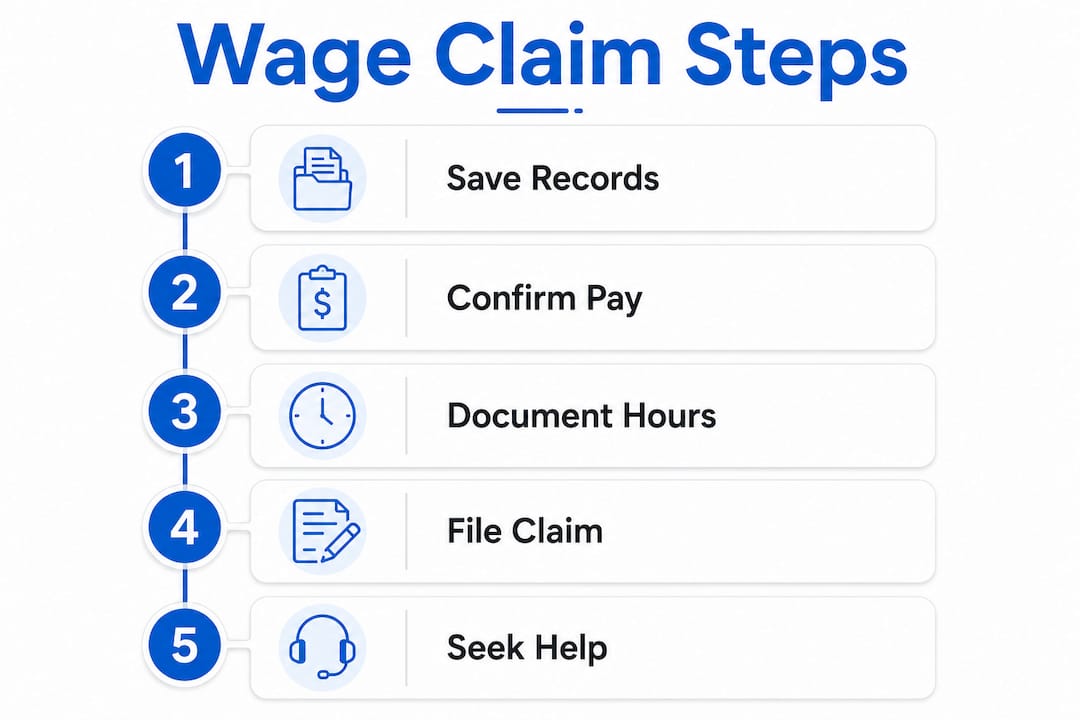
Documentation is your defense. Even without a written contract, you can build a strong case. Save every text message, voicemail, or social media message related to the job. Write down the names of coworkers who witnessed the agreement and the work. Take photos of the completed job before you leave the site. If the employer paid you partially, keep any cash receipts or bank records.
Pro Tip: Ask a coworker to send you a text confirming the agreed pay rate before the job starts. That message becomes a timestamped record of the verbal contract.
What legal recourse and claims processes are available to day laborers?
You do not need a written contract or legal immigration status to file a wage claim. Both federal and state agencies accept claims from all workers. The process is more accessible than most day laborers realize.
Filing a claim step by step
- Gather your documentation. Collect time records, text messages, photos, witness names, and any partial payment receipts before you file.
- File with your state labor agency. In California, that is the Division of Labor Standards Enforcement (DLSE), also called the Labor Commissioner’s Office. In Illinois, file with the Illinois Department of Labor.
- Submit a federal complaint. The U.S. Department of Labor’s Wage and Hour Division accepts FLSA complaints online, by phone, or in person.
- Attend the hearing. State agencies typically schedule a settlement conference first. If that fails, a formal hearing follows.
- Collect your remedy. Successful claims can recover back wages, interest, civil penalties, and attorney fees.
California Labor Code §1171.5 explicitly bars employers from using a worker’s immigration status as a defense against wage claims. Undocumented workers can recover the full range of remedies, including penalties and attorney fees, without fear of immigration consequences tied to the claim itself.
One honest caution: the wage claims process at government offices moves slowly. The Labor Commissioner’s office often takes months to resolve cases. That delay is a real systemic barrier, but it does not reduce the amount you can recover. Persistence pays.
| Remedy type | What it covers |
|---|---|
| Back wages | All unpaid hours at the applicable minimum or agreed rate |
| Overtime penalties | 1.5x pay for qualifying hours above daily or weekly thresholds |
| Civil penalties | Additional fines assessed against the employer for violations |
| Attorney fees | Legal costs recoverable in successful wage claims |
Pro Tip: Many nonprofit legal aid organizations offer free help filing wage claims. Search for a worker center or legal aid society in your city before paying for private legal representation.
What barriers do day laborers face in wage protections and how to overcome them?
The most dangerous barrier is fear. Employers illegally threaten to call Immigration and Customs Enforcement (ICE) when workers demand unpaid wages. That threat is a deliberate tactic to silence workers and avoid accountability.
Using a worker’s immigration status to retaliate against or intimidate them for asserting wage rights is illegal under California Labor Code §1171.5 and similar laws in other states. An employer who makes that threat has committed an additional violation, not a defense.
The law is clear on this point. Strong state laws explicitly prohibit employers from raising immigration status as a defense in wage disputes. Filing a wage claim does not trigger immigration enforcement. Labor agencies are not immigration agencies, and they do not share worker information with ICE for the purpose of wage investigations.
Practical steps to protect yourself while pursuing a claim:
- File claims through a nonprofit worker center if you are concerned about direct contact with government agencies.
- Bring a trusted advocate or attorney to any hearing or agency meeting.
- Document any retaliation threat in writing immediately after it occurs.
- Contact nonprofit wage theft campaigns that specialize in supporting day laborers facing intimidation.
Lack of documentation is the second major barrier. Workers who have no records face an uphill fight. The solution is to start documenting from day one of every job, before any dispute arises.
What are special state protections enhancing wage rights for day laborers?
Several states have passed laws that go well beyond the federal baseline. Knowing which rules apply in your state can significantly increase what you are owed.
| State law | Key protection |
|---|---|
| California Labor Code | $16.90/hour minimum wage in 2026; daily overtime after 8 hours; immediate final paycheck upon termination; no immigration status defense |
| Illinois Day and Temporary Labor Services Act | Equal pay required after 720 hours worked for the same client in 12 months, matching wages of comparable direct employees |
| Federal FLSA | $7.25/hour floor; overtime after 40 hours/week; applies in all states as a minimum |
The Illinois equal pay rule is one of the most significant recent advances in rights of temporary workers. Once you cross the 720-hour threshold with a single client, you are entitled to the same pay as a direct employee doing comparable work. That rule took effect as of march 2026 and directly targets the wage disparity between permanent and temporary workers.
Many cities also set their own minimum wages above the state level. Seattle, Chicago, and Los Angeles all have local ordinances that exceed state minimums. Always check the local rate for the city where you perform the work, not just the state rate. The most protective law between federal, state, and local levels is the one your employer must follow.
Key Takeaways
Day laborer wage protections are enforceable by law at the federal, state, and local levels, regardless of immigration status or the informal nature of the work arrangement.
| Point | Details |
|---|---|
| Federal wage floor | FLSA guarantees $7.25/hour and 1.5x overtime after 40 hours/week for all workers. |
| Stronger state rules | California pays $16.90/hour in 2026 with daily overtime; Illinois mandates equal pay after 720 hours. |
| Immigration status is irrelevant | California Labor Code §1171.5 bars employers from using immigration status as a wage claim defense. |
| Document everything | Time logs, texts, photos, and witness names are your strongest evidence in any wage dispute. |
| Claims are accessible | State labor agencies and the U.S. Department of Labor accept wage claims without a contract or legal status. |
The real cost of not knowing your rights
I have spent years reading wage theft cases, and the pattern that troubles me most is not the employers who steal. It is the workers who never file a claim because they believe the law does not apply to them. That belief is exactly what bad actors count on.
Day laborers carry a legacy of resilience. They show up, do hard physical work, and often do it without the safety net that formal employment provides. The law recognizes that vulnerability and responds with protections that are, in many states, stronger than what office workers receive. California’s daily overtime rule and Illinois’s equal pay threshold exist precisely because legislators understood the power imbalance in informal labor markets.
The systemic barrier I find most frustrating is the slowness of enforcement. Legal resolution for wage claims routinely takes longer than the wage theft itself lasted. That gap is a real injustice. But the remedy at the end of that process, including back wages, penalties, and attorney fees, is worth pursuing. Giving up is the only outcome that guarantees the employer wins.
My honest advice: do not wait until you have been cheated to learn these rules. Read them now. Share them with coworkers. The worker who knows the law before a dispute starts is in a far stronger position than the one who learns it after.
— Max
Workplacefairness resources for day laborers
Workplacefairness has been connecting workers with employment rights information since 1994. If you are a day laborer trying to understand your legal options, the guides on this site are written in plain language and cover the full range of wage and workplace protections.
Start with the workplace rights guide covering what every worker needs to know in 2026, including wage laws, overtime rules, and how to report violations. Workers in Illinois can also find targeted guidance on Illinois labor law alternatives that explain state-specific protections in accessible terms. Workplacefairness does not replace legal counsel, but it gives you the knowledge to ask the right questions and recognize when your rights have been violated.
FAQ
What is the minimum wage for day laborers in 2026?
The federal minimum wage is $7.25 per hour, but many states set higher rates. California’s minimum wage is $16.90 per hour in 2026, and local ordinances in cities like Los Angeles and Chicago may set even higher floors.
Can undocumented workers file a wage theft claim?
Yes. Immigration status does not affect your right to file a wage claim. California Labor Code §1171.5 explicitly prohibits employers from using immigration status as a defense, and undocumented workers can recover back wages, penalties, and attorney fees.
What counts as wage theft for a day laborer?
Wage theft includes nonpayment, underpayment below minimum wage, unpaid overtime, illegal deductions, and fabricated quality complaints used to justify withholding pay.
How do I file a wage claim without a written contract?
File with your state labor agency or the U.S. Department of Labor’s Wage and Hour Division. Text messages, photos of completed work, and witness statements serve as evidence in place of a formal contract.
What is the Illinois 720-hour equal pay rule?
Under the Illinois Day and Temporary Labor Services Act, day laborers who work more than 720 hours for the same client within 12 months are entitled to equal pay compared to direct employees doing similar work, as of march 2026.